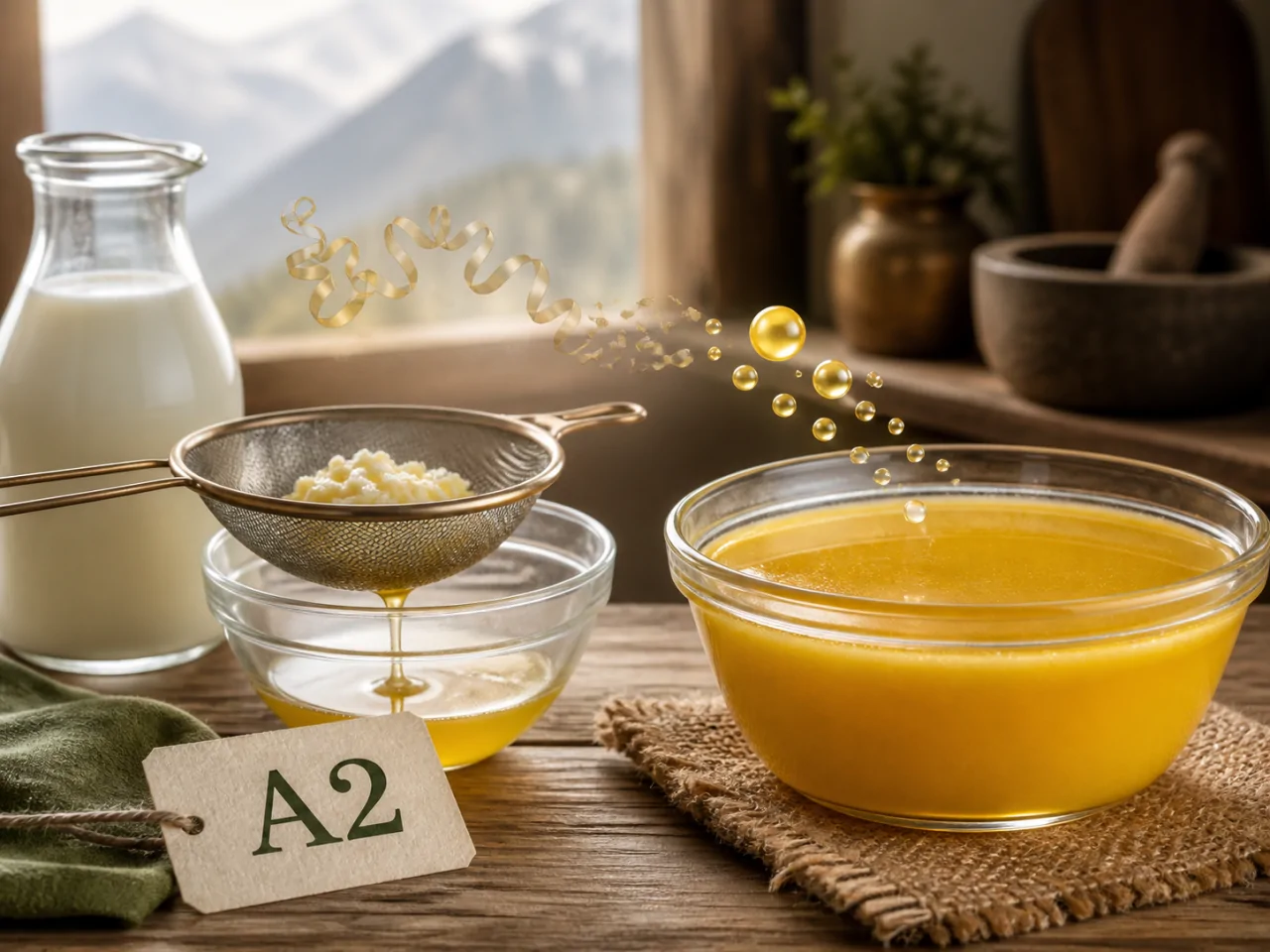
The short answer: A2 matters to a protein, not to the fat in ghee
A1 and A2 are genetic variants of beta-casein, one of the proteins in cow’s milk. The proposed A1-versus-A2 difference concerns what may happen when that protein is digested. Ghee is a different food: clarification removes water and milk solids so that the finished product is almost entirely milk fat.
That makes “A2 ghee” a weak nutritional distinction. If almost all beta-casein has been removed, there is essentially no A1 or A2 protein left to produce the protein-digestion effect being discussed. The milk used to make ghee still matters for provenance and fat quality, but an A2 label by itself does not make the finished fat healthier, purer, easier to digest, or more traditional.
A beta-casein variant
A1 and A2 differ at one position in the amino-acid sequence of the milk protein beta-casein.
Almost entirely milk fat
Indian standards specify at least 99.5% milk fat for ghee, with no more than 0.5% moisture.
Little relevance after clarification
The proposed A2 mechanism requires beta-casein; properly clarified ghee contains only trace non-fat solids, if any.
What is actually different between A1 and A2 milk?
Beta-casein accounts for roughly 30% of the protein in cow’s milk. The A1 and A2 variants differ at amino-acid position 67: A1 has histidine and A2 has proline. This small change can affect how easily digestion releases a seven-amino-acid peptide called beta-casomorphin-7, or BCM-7, from the parent protein.
This is a protein question. It is not a special kind of milk fat, vitamin, or mineral. Any plausible digestive difference therefore applies when a meaningful amount of the relevant beta-casein is present—as it is in milk—not simply because the cow that supplied the original milk carried an A2 genotype.
What happens to milk protein when ghee is made?
Ghee is produced by separating and clarifying milk fat. During heating, moisture is driven off and the non-fat milk solids separate from the clear fat and are filtered away. Codex describes ghee as a milk-fat product made by an almost total removal of water and non-fat solids. India’s current standard requires ghee to contain at least 99.5% milk fat and no more than 0.5% moisture.
Food-composition values and individual products can show tiny residual protein values because ingredients and processes vary and measurements have detection limits. “Virtually protein-free” is therefore more accurate than promising that every ghee contains literally zero protein. A product-specific claim should come from a validated laboratory test, not from the A2 status of the source milk.
Why milk findings should not be transferred to ghee
Some human trials report fewer digestive symptoms after people drink milk containing only A2 beta-casein instead of conventional milk containing both A1 and A2 variants. An independent systematic review rated the evidence for digestive symptoms as moderate, while rating evidence for other health outcomes low or very low. That is a narrower and more cautious conclusion than many advertisements imply.
These studies gave participants milk or other protein-containing dairy foods. They did not establish that ghee made from A2 milk has the same effect. Once beta-casein has been almost entirely removed, extrapolating a beta-casein digestion result to ghee loses the ingredient required for the proposed mechanism.
| Question | Milk | Properly clarified ghee |
|---|---|---|
| Is beta-casein present in a meaningful amount? | Yes; beta-casein is a substantial part of milk protein. | Only possible trace residual milk solids; ghee is almost entirely fat. |
| Can the proposed BCM-7 mechanism apply? | Potentially, because the parent protein is present. | Biologically implausible as a meaningful distinction when the parent protein has been removed. |
| Does “A2” prove easier digestion? | Some trials suggest fewer gastrointestinal symptoms for some people, but it is not a universal result. | No direct clinical evidence establishes an A2 advantage for ghee. |
| Does “A2” prove better fat quality? | No. A2 identifies a protein variant, not the fatty-acid profile. | No. Feed, season, handling, adulteration control, and storage are more relevant to the fat. |
Were A2 studies designed to be biased?
It is not scientifically fair to say that the studies were deliberately designed to be biased. What can be documented is that several prominent A2 milk trials were funded by The a2 Milk Company, used company-provided products, included company-affiliated authors, or reported sponsor involvement in manuscript drafting. Those are real conflicts of interest and good reasons to examine the methods, registration, outcomes, and reporting closely.
Industry funding does not automatically make a result false, and it does not prove misconduct or intentional bias. It does increase the importance of independent replication. It is also relevant that an independent systematic review still found moderate-certainty evidence for a digestive-symptom difference in milk, while finding low or very-low-certainty evidence for broader health claims. The responsible conclusion is neither “all A2 research is marketing” nor “A2 is proven better for everyone.”
What matters more when choosing ghee?
For ghee, useful questions concern the finished fat and how it was made: Is it genuine milk fat without vegetable-oil adulteration? Is the source traceable? Was moisture removed adequately? Was clarification controlled to avoid scorching and oxidation? Was it packed and stored well? If a producer makes nutritional claims, are they supported by tests on the finished product?
Breed, feed, pasture, season, and production system can influence milk yield and aspects of the milk-fat profile. Those are separate questions from A1 versus A2 beta-casein. A producer may value native breeds or A2 herds for agricultural, cultural, or sourcing reasons, but the A2 label alone does not demonstrate a nutritional advantage in the jar of ghee.
- Look for one clearly declared dairy ingredient and protection against adulteration.
- Prefer traceable sourcing and transparent preparation over a single premium label.
- Treat A2, grass-fed, native-breed, organic, and Bilona as different claims requiring different evidence.
- Ask for finished-product testing when a brand makes measurable composition claims.
- Do not use A2 ghee as a substitute for medical diagnosis or allergy advice.
The bottom line
A2 milk may be a meaningful choice for some people who experience digestive symptoms when drinking ordinary milk, although the evidence is not a licence for sweeping disease or wellness claims. Ghee is not milk: it is almost entirely the fat separated from milk, with virtually all beta-casein removed.
For that reason, the proposed benefit of A2 beta-casein generally does not carry over to ghee. Paying extra for “A2 ghee” on protein-digestion grounds is not supported by direct clinical evidence. Judge ghee by its authenticity, source, preparation, sensory quality, storage, and verified finished-product composition—not by a protein label on a product that contains virtually no protein.
Research references
- Food Safety and Standards (Food Products Standards and Food Additives) Amendment Regulations: standard for ghee and other milk-fat products. Food Safety and Standards Authority of India (2021). View research (opens in a new tab)
- Standard for Milkfat Products (CXS 280-1973). Codex Alimentarius, FAO and WHO. View research (opens in a new tab)
- Review of the potential health impact of beta-casomorphins and related peptides. European Food Safety Authority Scientific Report (2009). View research (opens in a new tab)
- Milk A1 beta-casein and health-related outcomes in humans: a systematic review. Nutrition Reviews (2019). View research (opens in a new tab)
- Effects of cow’s milk beta-casein variants on symptoms of milk intolerance in Chinese adults: a multicentre, randomised controlled study. Nutrition Journal (2017). View research (opens in a new tab)
- Effects of conventional milk versus milk containing only A2 beta-casein on digestion in Chinese children: a randomized study. Journal of Pediatric Gastroenterology and Nutrition (2019). View research (opens in a new tab)