Quality begins before preparation
No preparation method can add qualities that were not present in the milk to begin with. Studies show that what cows eat—including how grass is supplied—can change measurable features of milk fat, such as its fatty-acid and fat-soluble antioxidant profile. Breed, season, pasture quality, and overall farm management also contribute, so feeding should never be reduced to a decorative label.
This does not prove that diet is the single most important factor for every definition of quality. It does show that careful sourcing and cow nutrition are foundational, while processing determines how well that raw material is handled and how the finished ghee develops its aroma, flavour, and consistency.
Understanding the Bilona method
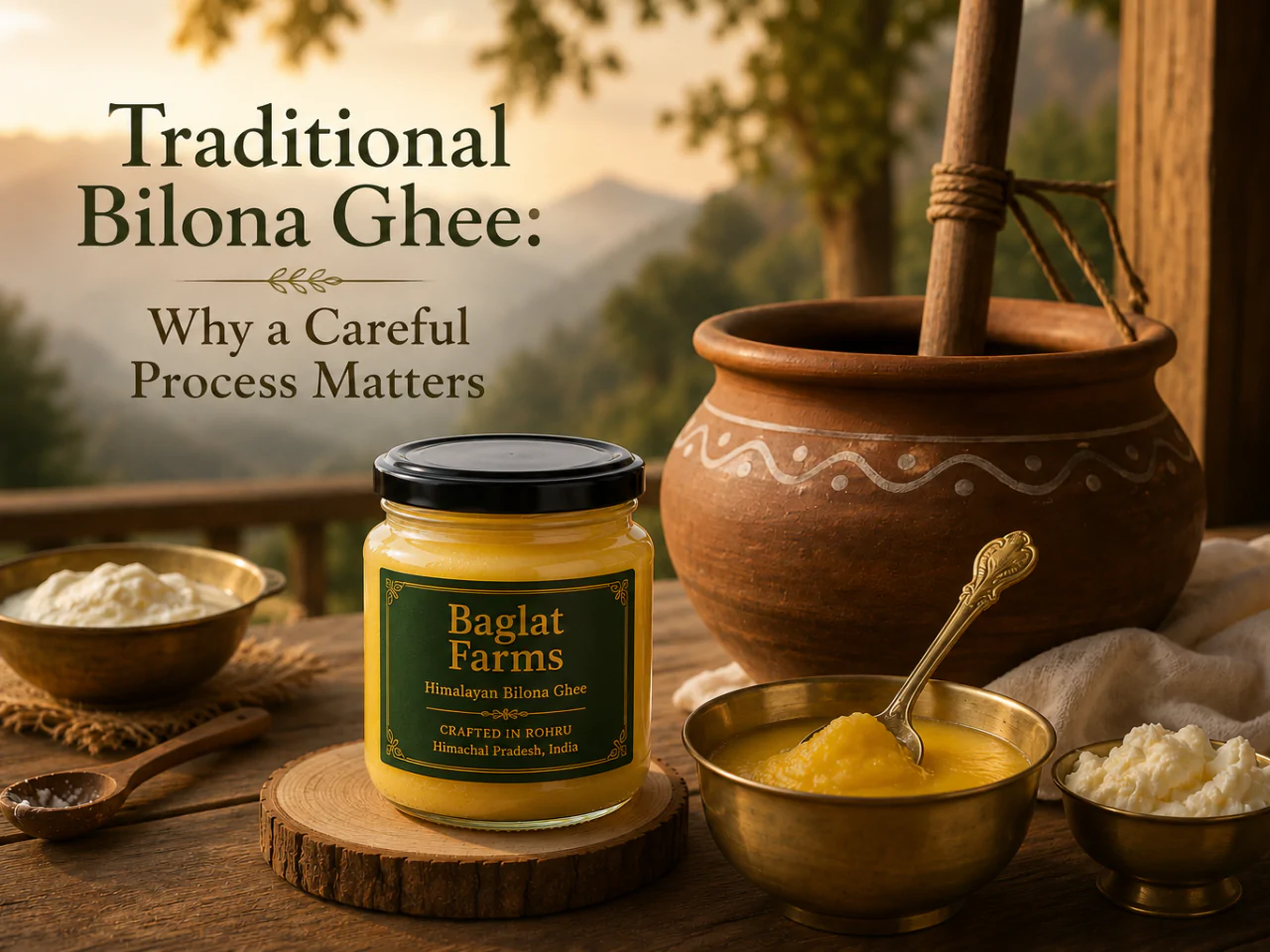
In the traditional Bilona method, milk is first set into curd. The curd is churned with a bilona to separate butter from buttermilk, and that butter is heated carefully until its moisture is removed and the milk solids separate from the clear golden fat.
The curd-first pathway defines the method, but the details still matter. Clean handling, careful culturing and churning, controlled heat, and patient clarification help preserve the character of good milk. At Baglat Farms, we work in small batches and give each stage the attention it deserves.
Process and flavour are connected
Heating and clarification do more than remove water. They create and release aroma compounds that contribute to ghee’s nutty, cooked, and buttery notes. Scientific analysis has shown that different raw materials and production choices can produce different volatile profiles, demonstrating that method has a measurable relationship with sensory character.
Careful temperature control helps develop aroma while preventing the milk solids from scorching. The point is not to prolong the process for its own sake, but to clarify the butter evenly and stop at the right moment.
Clarity without exaggeration
A production method should explain how ghee is made, not act as a shortcut to sweeping wellness claims. Ghee is a concentrated dietary fat, and individual dietary needs vary. Our focus is honest ingredients, thoughtful sourcing, and a traditional Bilona process that protects the character people value.
Research references
- The mode of grass supply to dairy cows impacts the fatty acid and antioxidant profile of milk. Foods (2020). View research (opens in a new tab)
- Evaluation of volatile compounds in different types of ghee using gas chromatography–mass spectrometry. Journal of Dairy Research (2002). View research (opens in a new tab)
- Docosahexaenoic acid content is significantly higher in ghrita prepared by traditional Ayurvedic method. AYU (2014). View research (opens in a new tab)